

What happened
Anthropic released Claude Haiku 5.5 on 7 October. It positions the model for frequent, tightly scoped work: sorting requests, extracting information and producing short summaries. The company also presents it as a helper that can handle smaller parts of a larger task. Its launch announcement describes it as its fastest small model, a vendor claim rather than an independent speed test.
The release matters because many useful software jobs are small. Identifying the topic of a support request is different from deciding how to resolve a difficult dispute. A lower bill for the first task could make it practical to run more often. That does not establish that the model should make the second decision.
The prices, and what they measure
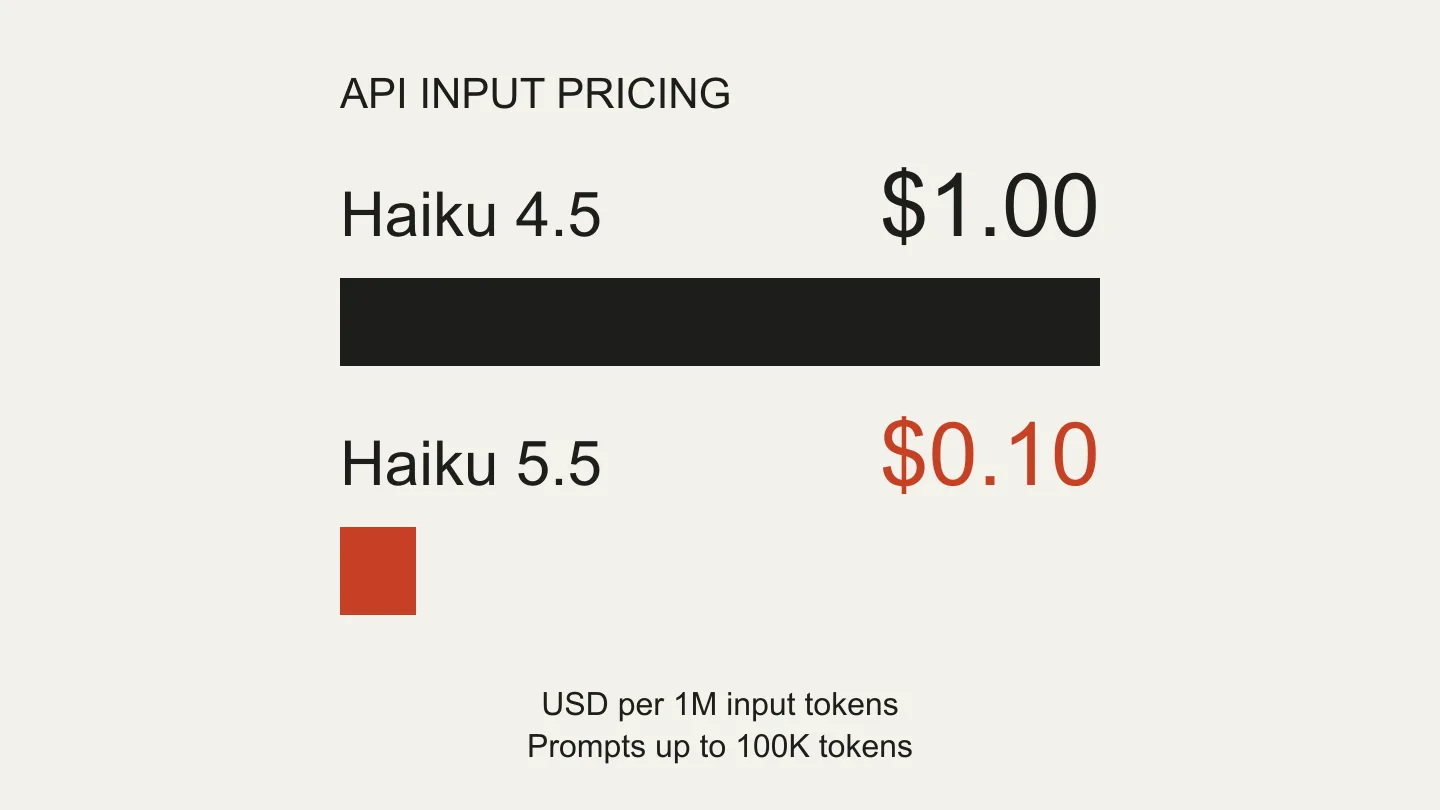
Anthropic’s price list charges Haiku 5.5 at $0.10 per million input tokens and $0.50 per million output tokens for prompts of up to 100,000 tokens. Haiku 4.5’s listed base rates are $1 and $5 respectively. These are developer API charges in US dollars, not a promise that a Claude subscription will become cheaper.
Here is an illustration, not a measured workload: exactly 1,000 input tokens and 200 output tokens cost $0.0002 at the new short-prompt rates, versus $0.002 at those older rates. This excludes caching, tools and other charges. It also assumes identical token counts; real requests need recounting.
A token is a billing unit, not a completed job
Tokens are the pieces into which a model divides text. A quoted rate tells you the price of those pieces; it does not tell you how many will be needed for a useful answer. Two attempts at the same job may consume different amounts.
The migration guide identifies a particularly important change: Haiku 5.5 uses a newer tokenizer. Anthropic says the same text produces approximately 30% more tokens than with Haiku 4.5, with the exact difference depending on the content. A team cannot take an old token count, multiply it by the new price and treat the result as a verified saving. It must measure the new count.
The longer-prompt tier changes the comparison
The model overview lists higher rates for prompts above 100,000 tokens: $0.50 per million input tokens and $2.50 per million output tokens. The cheapest advertised rates therefore do not apply to every request. The model can accept a much larger context window, but capacity and price are separate questions.
A support message or extracted paragraph may fit comfortably below the threshold. Sending a large file collection and a long conversation is a different case. Before estimating the bill, identify what the application actually sends, including repeated context. A short visible question does not guarantee that the complete request behind it is short.
Reasoning effort is another part of the bill
Haiku 5.5 supports an adjustable effort setting. Anthropic’s effort documentation explains that it influences how many tokens a response uses, including reasoning and tool-related output. This is a control over the model’s behaviour, not a strict guarantee of a particular token budget.
The practical choice depends on the job. Spending less time on reasoning may be sensible for a simple label that can be checked immediately. A complicated request with several constraints is different. Choose the setting by testing whether the result remains acceptable, rather than treating the lowest setting as a universal bargain.
Why cheaper small tasks could matter
SIGNAL analysis: the most useful consequence may be less conspicuous than a new chatbot answering a difficult question. Imagine software that checks incoming messages for a missing order number, or turns a long internal note into a short handover. These are hypothetical uses, not capabilities SIGNAL has tested on Haiku 5.5.
When the cost of each call falls, developers can consider tasks that were previously too marginal to justify. They could also reserve a more capable model, or a human, for the cases that need judgment. That is an opportunity, not an obligation to automate.
The boundary matters. A draft label can be reviewed before anything happens. A mistaken refund decision, account change or safety instruction has consequences outside the text box. Lower token prices do not lower those consequences. A sensible design asks what must be checked before an answer changes a person’s situation.
The test is cost per correct result
Anthropic’s cost guidance recommends comparing models on cost per completed task, rather than the price of a token alone. That is a useful starting point, though its own performance examples remain vendor evidence.
SIGNAL’s suggested test is straightforward: choose real examples with known acceptable outcomes, include the awkward cases, and compare accuracy, time and total spending. Count retries and escalation to another model. Record how much human review the output still needs.
A cheap first answer is not the final cost if it has to be corrected. Equally, a smaller model need not be dismissed because a larger one performs better on a difficult benchmark. The question is whether this particular task is completed reliably enough for its intended use. No single leaderboard supplies that answer.
What the announcement does not establish
The launch includes benchmark comparisons and early customer feedback. Those are reasons to investigate, not proof that a reader’s own application will obtain the same result. SIGNAL has not run a hands-on evaluation of Haiku 5.5, and this article does not rank it against competing models.
Anthropic itself distinguishes Haiku’s narrower tasks from the more complex coding work for which it recommends larger models. That makes the scope of the release more important than a broad claim that a cheaper model can replace every other one.
The open questions are practical: accuracy on difficult examples, delays under the intended workload, the amount of review required and the cost of failures. They need application-specific evidence.
What happens next
Developers evaluating a switch should first recount representative prompts and measure results at the intended effort setting. Migration is also an integration change: existing requests may need updating, so a model-name swap alone should not be treated as a complete test. Anthropic documents those changes in its migration guide.
SIGNAL will watch for independent, clearly described evaluations and evidence from sustained use. A useful follow-up would explain the workload, settings, failure criteria and full cost, rather than announce a percentage saving without its assumptions.
For readers, the change worth understanding is that one class of AI work now has lower listed prices. Whether that becomes better or more affordable software depends on what people build with it, and how carefully they check the result.
Original sources
- anthropic.comAnthropic — Haiku 5.5 launch, 7 October 2026
- platform.claude.comClaude Platform — pricing
- platform.claude.comClaude Platform — Haiku 5.5 overview and availability
- platform.claude.comClaude Platform — migration guide
- platform.claude.comClaude Platform — effort
- platform.claude.comClaude Platform — cost per completed task
Sources checked 8 October 2026. Send a correction.