
What Tesla is reporting
Tesla says Optimus production has begun in Fremont, California. Its 21 October quarterly update describes the first robots from the line as production-quality units, while acknowledging that both the hardware and manufacturing process will keep changing.
The company’s manufacturing table labels California Optimus operations as Early Ramp and the Texas project as Construction. Neither entry carries a numerical annual capacity. Tesla also says its current manufacturing process is suitable for a commercial product. That is the manufacturer’s assessment, not an independent certification or a measurement of customer deployment.
The million-robot figure needs its date
In its April update, Tesla described a first-generation Fremont line designed for one million robots a year, replacing the Model S and Model X lines. It also described a second-generation Texas line being designed for a long-term annual capacity of ten million.
Those were design ambitions. They did not mean that either site was already building robots at those rates. The April table listed both Optimus projects as under construction.
A planned annual capacity is a description of an intended factory, not a count of completed machines. It cannot tell a reader how many robots passed inspection last week, how many required rework or how long the line actually operated. Keeping those questions separate prevents a long-term ambition from becoming an imaginary production result.
Why making the same robot repeatedly matters
A prototype and a repeatable product answer different engineering questions. A demonstration can show that a mechanism is possible. Manufacturing asks whether many examples can be assembled consistently, repaired and supported without rebuilding each one as a special project.
For a humanoid robot, SIGNAL would look for evidence about how consistently units are built, how often components need replacement and what changes are still required between batches. A beautiful movement in a video does not answer those questions.
This is why an early manufacturing ramp can be meaningful without being the end of the story. The next useful disclosures would turn a general progress claim into something readers can compare over time: completed units in a defined period, a clear definition of what counts as completed, and evidence about reliability.
Production is not the same as autonomy
There is another distinction: producing the body does not establish what it can reliably do. A robot might be physically capable of a task while still depending on close supervision, a carefully prepared setting or a human operator.
To evaluate a future work demonstration, ask what instructions the robot received, whether anyone intervened, how many attempts were needed and how long it continued. A task completed once is different evidence from the same task completed across a full working shift. These are evaluation questions, not claims that a particular Optimus demonstration used a particular control method.
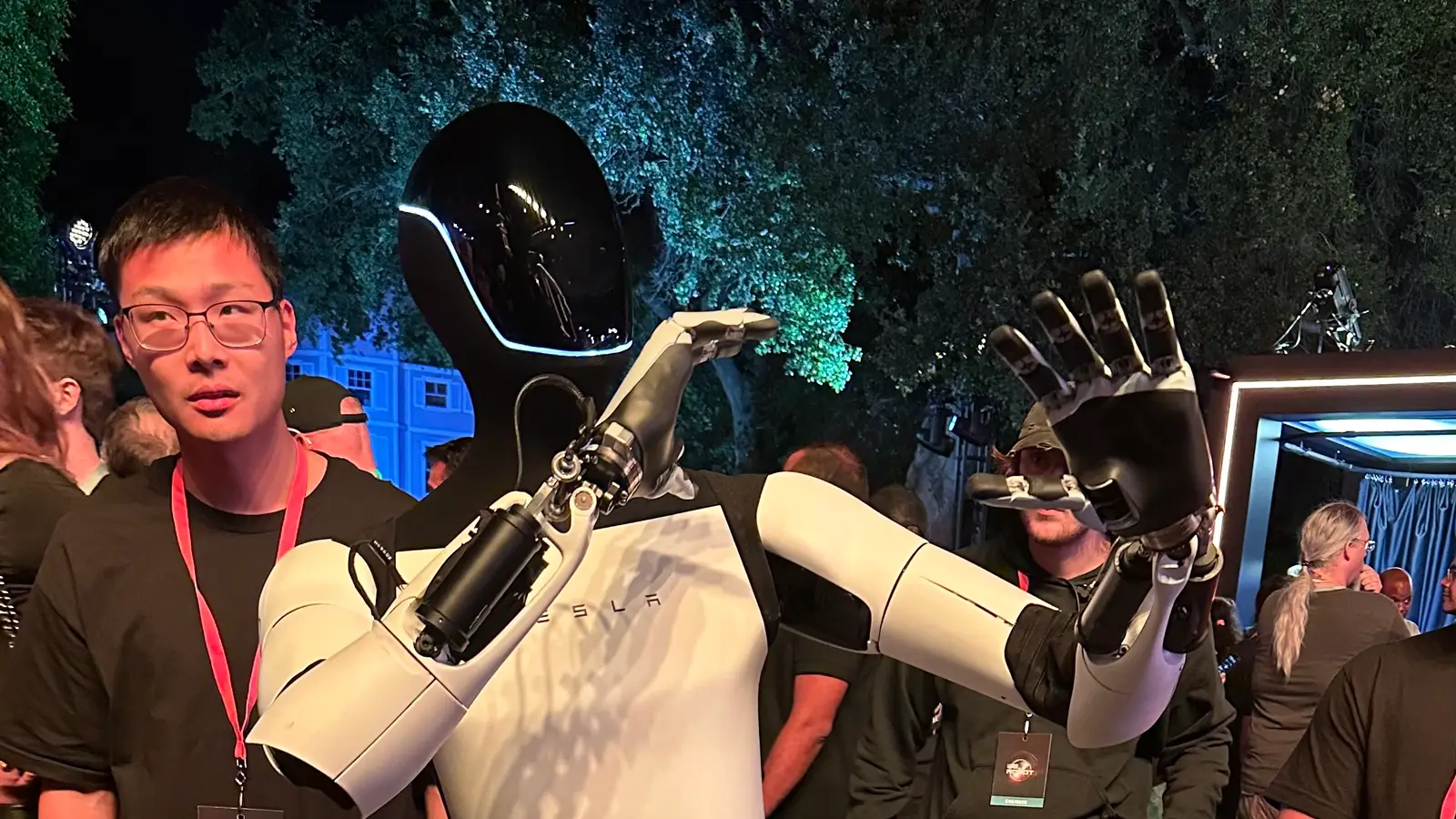
SIGNAL has not visited the line or tested Optimus. This report is based on Tesla’s published updates. The photograph is from the October 2024 event and must not be read as a picture of the new production line, the current hardware revision or proof of autonomous work.
What would make the next milestone convincing
The strongest follow-up would connect manufacturing evidence with a clearly described job: how many robots were deployed, what they actually did, how often people had to help and how much maintenance the work required.
That would let readers distinguish a promising industrial experiment from a dependable tool. Starting a line is one kind of progress. Showing that its output can perform useful work repeatedly is the next test.
Original sources
- ir.tesla.comTesla — Q3 2026 Update, 21 October; Manufacturing & Hardware, printed page 6
- ir.tesla.comTesla — Q1 2026 Update, 22 April; factory design targets, printed page 6
- commons.wikimedia.orgPhotography — Steve Jurvetson, Latest Tesla Optimus Humanoid Robot, 10 October 2024
- creativecommons.orgImage licence — Creative Commons Attribution 2.0

Sources checked 23 October 2026. Send a correction.