
What Tesla has actually presented
Tesla unveiled its new Roadster on the evening of 15 October in Texas. Car and Driver’s event report describes a car driving along an inverted ramp before leaving it and returning to the ground. Tesla’s official livestream is available as a recording. This is a product presentation, not an independent vehicle test.
The company’s own Roadster page provides the crucial distinction. It describes Performance, Thrust and Rocket configurations, with different seating arrangements and purposes. The Rocket is the single-seat version associated with airborne movement, and Tesla explicitly says it is not approved for public road use.
That qualification should travel with every claim that Tesla has made a flying car. It separates what an experimental or specialist vehicle can demonstrate in a controlled setting from what a customer may legally drive through a town. It also prevents the most dramatic version from becoming a promise about every Roadster.
Sticking to a surface and leaving it are different jobs
Tesla describes two mechanisms that are easy to confuse in a short clip. One draws air from beneath the car to create suction. The other uses cold-gas thrusters to push the vehicle. The company also lists active aerodynamics, meaning surfaces whose position can change to influence the surrounding airflow.
Think of suction as helping hold the car against a surface. Reducing the air pressure underneath allows the surrounding air to press it toward that surface. Tesla says its fan and ground-sealing system can hold the vehicle upside down, including while stationary. That is the manufacturer’s capability claim; SIGNAL has not measured the force or tested the system.
Thrusters do a different job: they expel gas to produce a push. Tesla says the Rocket places them around the vehicle to support upward and forward acceleration and rotation. Its page says fine adjustments help stabilize the vehicle in flight. Calling them cold-gas thrusters does not mean the car carries a combustion rocket engine.
SIGNAL explanation: holding a car against a ramp, making it leave the ramp and controlling its orientation afterward are separate control problems. A video can make them look like one seamless trick. Understanding the difference helps readers ask what equipment and operating conditions each stage requires.
Three configurations, not one universal promise
Tesla describes Performance as a two-seat, road-oriented configuration with active aerodynamics and suction. Thrust retains two seats and adds rear-mounted cold-gas thrusters. Rocket is invite-only, has one seat and adds thrusters positioned for movement in more directions. These are Tesla’s descriptions, not a SIGNAL assessment of homologation or customer availability.
The distinction matters when a headline combines the acceleration of one configuration, the seating of another and the airborne movement of a third. Readers can end up imagining a product Tesla has not actually described. Its page also warns that Rocket is not available in every region.
SIGNAL analysis: compare a specific configuration with a specific intended use. A capability in a specialist variant should not be assumed to exist in the ordinary car. Nor should the presence of a reservation link be treated as evidence of a confirmed delivery date, a final purchase price or approval to use every feature on a public road.
What the demonstration does not settle
A public demonstration is more informative than a promise alone, but it is a narrow kind of evidence. It does not establish how the vehicle behaves across changing surfaces, weather conditions, repeated use or component failures. Those are questions for disclosed testing, not conclusions that can be read from a dramatic landing.
SIGNAL analysis: useful follow-up information would include the permitted operating envelope—the conditions in which a function is intended to work. For airborne movement, that means questions about height, duration, control, exclusion zones and recovery when something goes wrong. For suction, readers should look for surface requirements, sealing limitations and the consequences of losing downforce.
The practical questions also include how the gas supply is replenished, how often components need inspection and what maintenance a customer must arrange. This article does not assign figures to those unknowns or infer usable flight duration from the appearance of a pressure tank.
Tesla’s public-road restriction for Rocket is already explicit. Other approvals, final regional terms and customer deliveries require their own evidence. A road restriction is not the same thing as a complete statement of aviation requirements, and this article does not offer legal clearance for operating the vehicle.
Why it is still a technology story
The interesting idea is active control over how a car interacts with its surroundings. Conventional descriptions emphasize motor output and tire grip. Tesla’s presentation puts suction, movable aerodynamic surfaces and directional thrust at the center of the discussion.
SIGNAL analysis: that combination makes a useful engineering explainer even if the airborne feature remains highly specialized. It invites readers to distinguish traction from thrust and a controlled maneuver from a transport service. The value of the story is not a prediction that commuting cars will soon take to the sky.
It also changes what a meaningful evaluation should examine. A single acceleration number cannot answer questions about operating restrictions, repeatability, energy use, maintenance or safety. More hardware can enable additional maneuvers while also introducing additional dependencies. Whether that trade-off is useful depends on the intended activity and the evidence behind it.
What to watch next
Car and Driver reports that Musk said production would begin in 2028. That is a stated target, not a verified delivery schedule. Watch for configuration-specific specifications and published operating limitations. Independent demonstrations and repeatable measurements would help separate the presentation from the experience of owning and using the vehicle.
Until then, the careful description is a Roadster demonstration alongside Tesla’s claims for specialist configurations. The Rocket’s airborne capability does not make the whole range an everyday flying-car proposition.
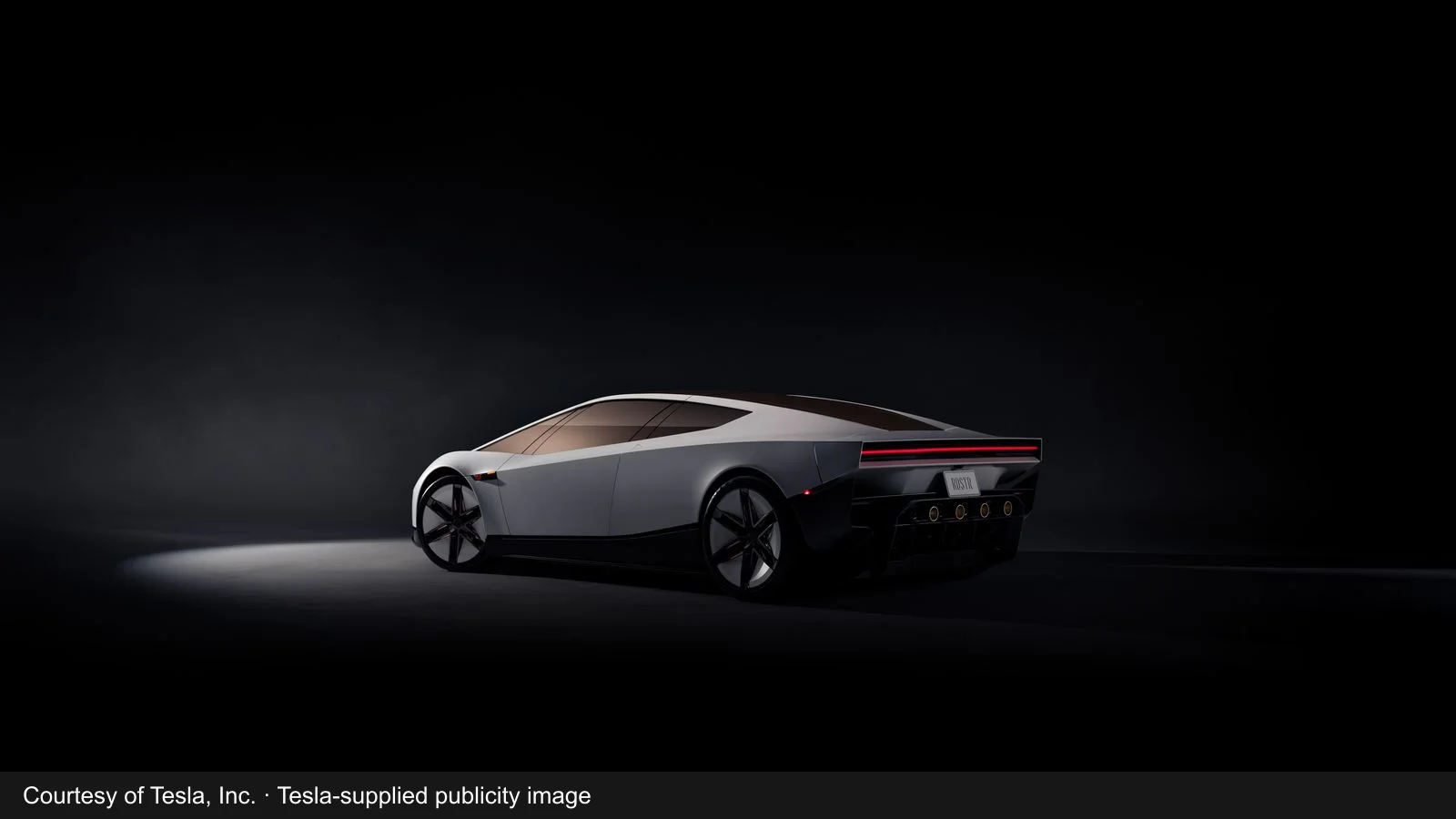
SIGNAL has not driven the Roadster, inspected its hardware or independently verified its performance. The image accompanying this article is Tesla-supplied publicity material, not a SIGNAL photograph of the demonstration. The original sources below let readers examine the company’s descriptions and event recording directly.
Original sources
- tesla.comTesla — Roadster configurations, mechanisms and public-road restriction
- livestream.tesla.comTesla — Official Roadster event recording
- x.comTesla — Original Roadster broadcast on X
- caranddriver.comCar and Driver — Reporting from the Roadster unveiling, 16 October 2026
Sources checked 16 October 2026. Send a correction.