
SpaceNews
Amazon lost 40 Leo satellites on Vulcan’s first failure. It has 37 more Vulcan launches booked.
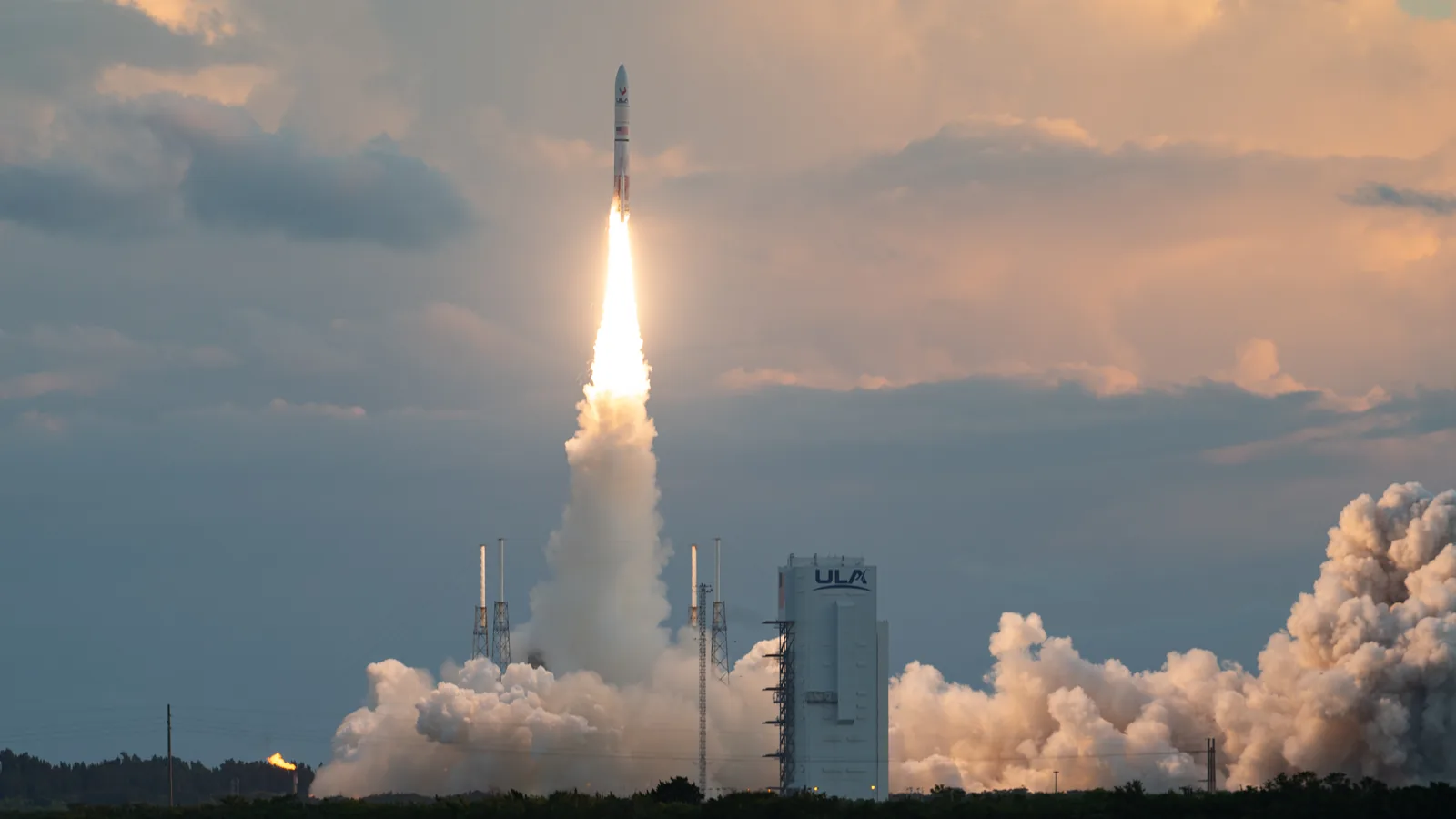
A United Launch Alliance Vulcan rocket failed ten minutes after liftoff on Sunday, 15 November, and Amazon’s 40 Leo internet satellites were lost. It was the first of 38 Vulcan launches Amazon has under contract, and the cause is not yet known.
In short
- What happened. On Sunday, 15 November, a ULA Vulcan rocket failed ten minutes after liftoff from Cape Canaveral. Amazon says the payload, 40 Leo internet satellites, was lost.
- Who is affected. Amazon Leo, which planned to put close to half of its first-generation network on Vulcan, and other Vulcan customers, including the US Space Force.
- The catch. ULA says it has no data yet on the cause. Until it does, nobody can say when Vulcan flies again, or what that does to Amazon’s timetable.
40Amazon Leo satellites lost on Sunday’s launch, per ULA and Amazon
10 mininto the flight when the rocket “suffered an anomaly”, per ULA’s statement
38Vulcan launches Amazon has on contract with ULA; this was the first, per Amazon
What happened on Sunday
The Vulcan lifted off from Space Launch Complex-41 at Cape Canaveral, Florida, at 12:40 p.m. EST on Sunday, 15 November. It carried 40 satellites for Amazon Leo, the satellite internet network formerly called Project Kuiper.
About 50 minutes later, United Launch Alliance (ULA) said the rocket “suffered an anomaly 10 minutes into the flight and failed to deliver the Amazon mission to orbit”. That sentence comes from a ULA update quoted by Spaceflight Now and Space.com. SIGNAL found no failure statement on ULA’s own news pages.
Amazon confirmed the outcome in a note on its mission page: ULA “experienced an anomaly” and “the payload was lost”.
It was the fifth Vulcan flight. Spaceflight Now calls it the first outright failure of a ULA rocket since Boeing and Lockheed Martin formed the company in 2006.
Forty satellites equals a tenth of everything Amazon had launched
Amazon says it has launched “nearly 400 satellites to date across 14 missions”. Sunday’s payload was therefore equal to about a tenth of everything the company had put up so far. That ratio is SIGNAL’s arithmetic, not an Amazon figure.
The finished network is far larger. ULA describes it as more than 3,000 satellites. Amazon says Vulcan alone is meant to carry “1,500+ first generation Leo satellites across 38 missions”, which works out to about 40 per flight.
This was the first of those 38. Amazon lost one launch. It still has 37 riding on the same rocket.
Amazon has not said what the 40 satellites cost or whether they were insured. No source SIGNAL read gives either answer.
Vulcan was meant to be the workhorse
Amazon did not bet on one rocket. Spaceflight Now counts 38 launches booked on Vulcan, 24 on Blue Origin’s New Glenn, 24 on Europe’s Ariane 6 and 13 on SpaceX’s Falcon 9.
But Vulcan holds the biggest share. Melissa Wuerl, Amazon Leo’s director of launch systems, put it this way in a quote Amazon first published in March and repeated on 9 November: “Vulcan will launch close to half our first-generation constellation.” She called it Amazon’s “primary workhorse” for the next several years.
Before Sunday, Amazon wrote that a second Vulcan mission was already being prepared and was “expected to launch within weeks of a nominal LV-01 mission”. LV-01 was Sunday’s flight. It was not nominal.
Spaceflight Now’s summary is blunt: Amazon will have to wait for ULA’s investigation before trying again with a Vulcan.
Blue Origin New Glenn24 launchesBooked, per Spaceflight Now.
Arianespace Ariane 624 launchesNext Leo flight: no earlier than 23 November, per Amazon.
SpaceX Falcon 913 launchesBooked with the company that runs Starlink.
ULA Vulcan38 launchesFirst one failed on 15 November. The next waits for the investigation.
The rocket had just been cleared to fly again
Sunday was a return to flight. Vulcan had not launched for nine months while ULA and its booster supplier, Northrop Grumman, worked on nozzle problems with the solid rocket boosters. Those problems marred two earlier flights, in 2024 and in February 2026, according to Spaceflight Now. In both cases the rocket still reached orbit.
After the February flight, the US Space Force put Vulcan launches of national security payloads on hold, the same outlet reports.
Sunday’s rocket flew with six of those boosters, the most Vulcan can carry. ULA wrote before launch that the nozzle changes had “been tested thoroughly”. Spaceflight Now says the boosters appeared to work normally.
So the suspected weak point held. Something else broke.
What ULA knows so far: almost nothing
ULA’s first statement was candid. “Since the anomaly just occurred, we don’t have any specific data yet to understand what occurred today,” the company said, as quoted by Space.com. It promised to find the cause and “return to flight as quickly as possible”.
ULA has not named the part that failed. Spaceflight Now’s reporter noted that the first stage appeared to burn longer than planned and to separate late, and that an on-screen animation showed the Centaur upper stage making unusual moves early in its burn. Those are a journalist’s observations of the broadcast. They are not findings.
One detail is worth keeping in mind. Amazon and ULA both wrote before launch that this mission was the first to fly a shorter Centaur V built for low orbits. Nobody has linked that change to the failure. SIGNAL is not suggesting a cause.
The same weekend, SpaceX caught a Starship
The timing is hard to ignore. On Saturday, 14 November, one day before the Vulcan failure, SpaceX caught the upper stage of its Starship rocket with its launch tower for the first time, Space.com reports. The ship had deployed 26 next-generation Starlink satellites. Starlink is the network Amazon Leo is built to compete with.
The comparison needs care. Starship is still a test programme, and Space.com reports that its booster was lost in the Gulf of Mexico on the same flight. Amazon is also a SpaceX customer: 13 of its booked launches are on Falcon 9.
Still, the weekend showed the gap in plain terms. One company recovered a vehicle from orbit. The other lost 40 satellites in ten minutes.
What Amazon says, and what it has not said
Amazon’s statement stands by its supplier: “There is risk with any launch, and that’s especially true for inaugural missions like LV-01.” It adds that ULA “has been a trusted partner”.
Amazon has not said whether its schedule changes. Six days before the launch, it wrote that it expected to expand service “following an initial service rollout later this year”. It has not updated that sentence.
Its next launch does not depend on Vulcan. Arianespace is due to launch 36 Leo satellites on an Ariane 6 from French Guiana no earlier than Monday, 23 November, according to Amazon.
SIGNAL did not find a statement from the US aviation regulator, the FAA, in the sources it read. We also did not read the US telecom regulator’s filings on Amazon’s deployment deadlines, so this article does not assess them.
Original sources
- aboutamazon.comAmazon — Amazon Leo mission updates, with statement on the LV-01 loss (updated 15 November 2026)
- aboutamazon.comAmazon — Amazon Leo’s first Vulcan mission, pre-launch article (9 November 2026)
- blog.ulalaunch.comUnited Launch Alliance — Vulcan Leo 1: Delivering 40 satellites to space, pre-launch post (10 November 2026)
- spaceflightnow.comSpaceflight Now — ULA suffers first outright failure with loss of Vulcan rocket (15 November 2026)
- space.comSpace.com — Vulcan Centaur rocket fails during return-to-flight launch (15 November 2026)
- space.comSpace.com — SpaceX catches Starship upper stage for the first time (14 November 2026)
- commons.wikimedia.orgWikimedia Commons — U.S. Space Force photo 241004-X-PM547-1033 by Airman 1st Class Collin Wesson, 4 October 2024 (its use does not imply U.S. Department of Defense endorsement)

Sources checked 16 November 2026. Send a correction.