
What AMD announced
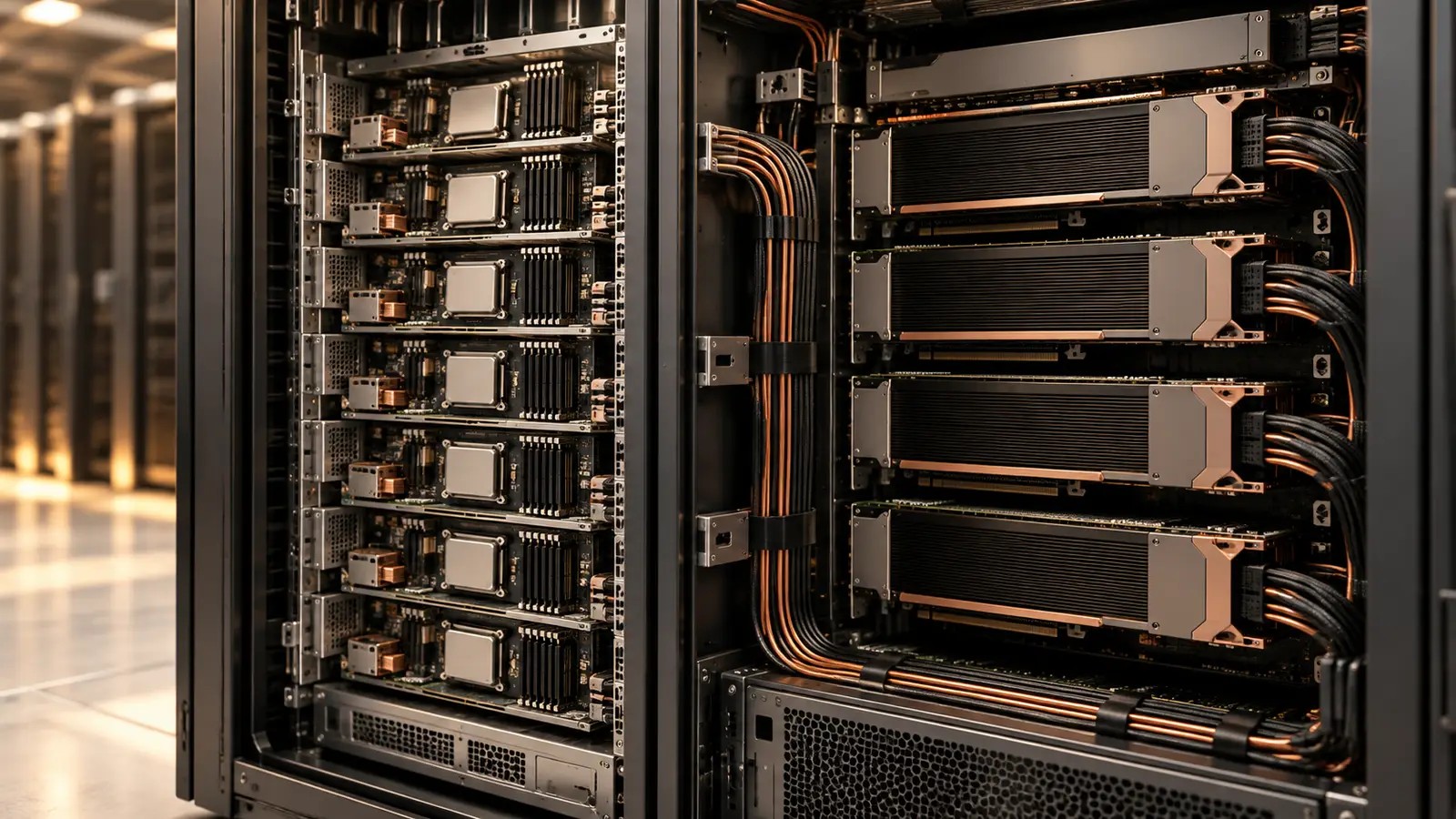
AMD introduced Helion on 12 October as an open reference design for agent infrastructure. It describes CPU-only racks and combined CPU/GPU systems, with air- or liquid-cooled options. The company plans to contribute the specification to the Open Compute Project. Partner configurations are under development, with availability planned for November 2026.
That is a product announcement and a timetable, rather than evidence of broad deployment. A reference design gives partners a starting point for building systems; it is not one finished machine with a universal price and performance result. SIGNAL has not tested Helion.
An agent has work to do between model calls
An AI model can produce an answer. An agent application wraps that model in software that can request information, call tools and continue through several steps. Those surrounding steps are also computing work.
AWS describes the CPU side of agent pipelines in its infrastructure guidance: assembling context, running tools, checking responses, handling memory and coordinating the sequence. GPUs remain important for accelerated model inference, which means running a trained model to obtain a result. But waiting for a database or preparing a request is not the same operation as generating that result.
Consider a hypothetical support assistant that looks up an order, asks a model to draft a reply, checks whether the reply contains the correct order details and then requests human approval. That example is not a Helion demonstration or a SIGNAL benchmark. It simply makes the division easier to see. The model produces language; other software performs and checks the surrounding work.
The split is not absolute. AWS also discusses CPU inference for suitable smaller models. The sensible hardware choice depends on the task. The point is to identify each part of a workflow before assuming that all of it needs the same accelerator.
Two configurations, different assumptions
AMD positions the CPU-only configuration for operators that already have separate infrastructure serving AI models. Its enterprise configuration combines CPU and GPU blades in one rack. The product page describes routing inference requests to cloud models or open-source models hosted locally.
AMD lists upper bounds of 32,768 CPU cores and 16 MI350P GPUs. These are advertised configuration limits, not a promise that every rack contains both maxima or completes a given number of agent tasks. The enterprise FAQ says its two GPU nodes operate independently, without a shared scale-up GPU fabric between them.
That detail matters when comparing products. AMD distinguishes Helion enterprise systems from its Helios GPU rack for frontier-scale training and large-scale inference. Similar names do not make them interchangeable. A buyer needs the actual configuration, model-serving requirements and software support, rather than an assumption that one rack is a smaller version of the other.
Open hardware is a starting point, not a compatibility guarantee
The Open Compute Project developed Open Rack as an open approach to rack infrastructure. Its original explanation describes a design spanning mechanical, electrical and thermal considerations. Open standards can therefore concern the system around a processor, not just the processor itself.
SIGNAL analysis: shared specifications are useful when operators need to understand how equipment will fit together, be powered and be maintained. They can make the requirements more inspectable. That does not remove the need to verify a particular system.
A rack that follows an open design still has specific parts, firmware, cooling requirements and support arrangements. Replacing a component is only sensible if the proposed replacement is compatible and supported. Likewise, an open hardware specification does not automatically make an application portable or make proprietary models available locally. Those are different layers, with different conditions to check.
The useful measurement is a completed job
SIGNAL analysis: the question for an operator is not simply how much compute can fit into a cabinet. It is whether the complete service becomes more useful, reliable or economical. A fast model call is only one part of that service.
Before comparing systems, define a job precisely. For a support workflow, that might mean a correctly resolved request, with the required checks and human intervention counted. For a coding workflow, it might include execution and validation rather than stopping when the model emits a plausible change. These are examples of evaluation design, not tests SIGNAL has performed.
Then measure the complete route: model use, tool execution, failures, retries, waiting time and the final result. Energy and cost comparisons also need a consistent workload and clear accounting boundaries. If one result excludes model-serving infrastructure while another includes it, the figures describe different things. A hardware announcement alone cannot settle that comparison.
More execution capacity does not grant an agent permission
SIGNAL analysis: hardware capacity and software authority should remain separate. A system can execute more work without being allowed to access more records or make more consequential decisions.
In the hypothetical support example, looking up an order, drafting a reply and issuing a refund are different actions. An organization should decide which actions are permitted, what information they require and when a person must approve them. Putting the workflow on dedicated hardware does not answer those questions.
It is also useful to distinguish an error that stays in a draft from one that changes another system. Checking a response after an irreversible action is a weaker safeguard than checking the action beforehand. Helion is infrastructure, not proof that a particular agent is safe. Any claim about secure or dependable operation needs evidence about the implemented software and its controls, as well as the machine.
What this means for readers who are not buying a rack
Most readers will encounter this kind of infrastructure through a service, rather than by purchasing it. The visible result might be an assistant that can follow a useful sequence, or software that handles routine steps while leaving difficult decisions to a person. Those outcomes are possibilities, not benefits already demonstrated by Helion.
The announcement is worth understanding because it changes the framing of the infrastructure question. Asking which model generates the best answer is different from asking what a system needs to carry out a job around that model. Both questions matter.
For a consumer, a larger server installation does not establish that an assistant is more accurate, private or affordable. Those properties depend on the service itself. Look for concrete improvements in the product you use, documented data handling and clear limits on what it can do. A back-end hardware name is not a substitute for that information.
What to watch next
AMD’s stated November availability target is the first checkpoint. Actual partner configurations, pricing and support documentation will determine what customers can obtain. The planned OCP contribution should also be distinguished from a specification that has already been published and adopted.
After that, useful evidence would show complete workflows on disclosed configurations, with failures and operating costs included. SIGNAL has not verified independent Helion performance or efficiency results. Until such evidence is available, the strongest conclusion is about the architecture: agents need coordinated execution around a model, and AMD is proposing hardware configurations built around that distinction.
Original sources
- newsroom.amd.comAMD — Helion announcement, 12 October 2026
- amd.comAMD — Helion configurations, specifications and FAQ
- docs.aws.amazon.comAWS — CPU inference and agent orchestration guidance
- opencompute.orgOpen Compute Project — Introducing the Open Rack (background)
Sources checked 13 October 2026. Send a correction.