
What Apple announced
Apple introduced HomeView on 13 October. US pricing starts at $299; wall mounts cost extra. The EU is excluded from launch sales, which Apple attributes to Siri AI’s unavailability in iOS there. No European release date is confirmed. SIGNAL has not tested the device.
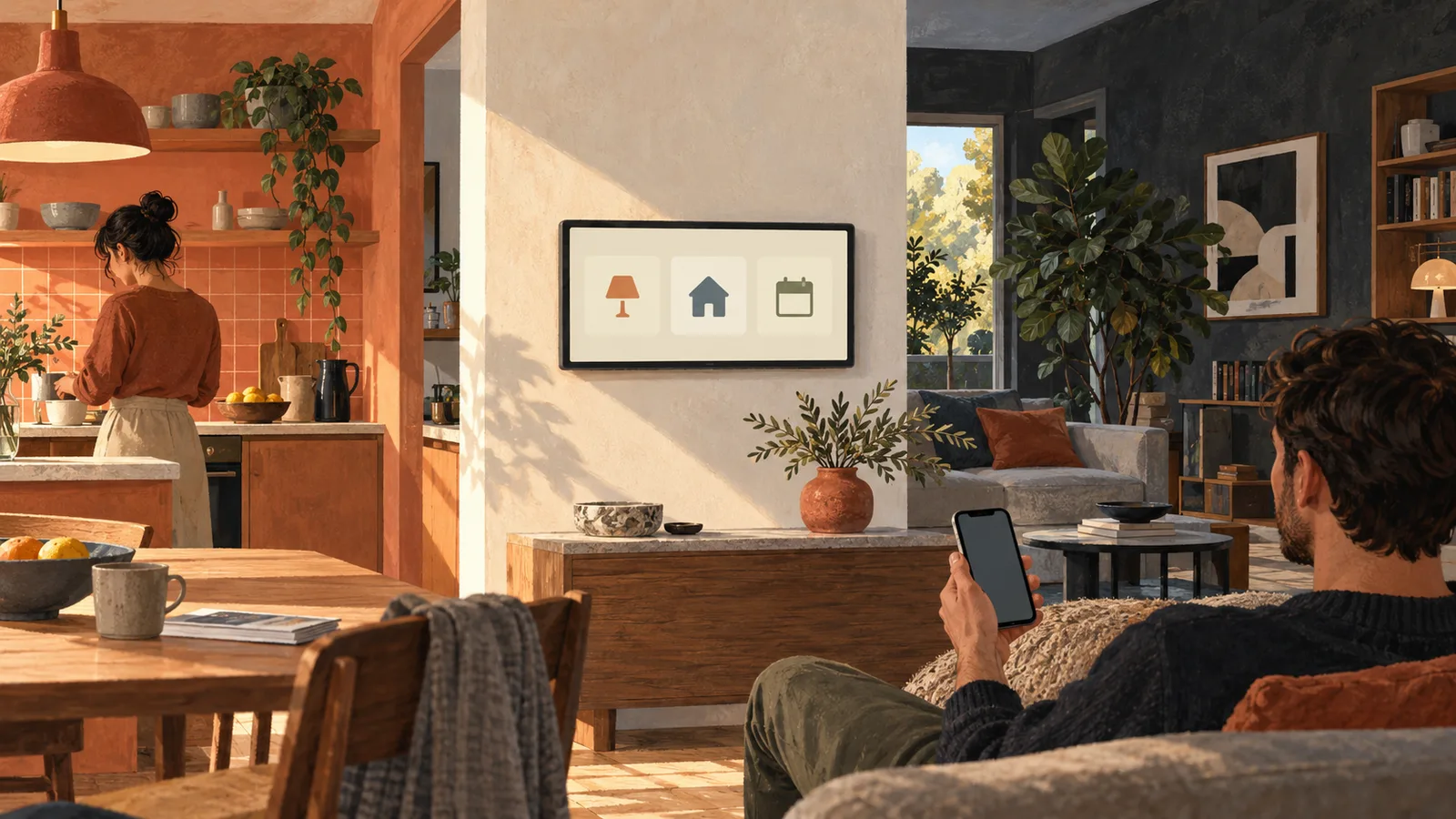
For the markets receiving it, the proposition is a screen that belongs to the home rather than to one person. Whether that is useful depends less on another display existing than on what people can do with it, and what it keeps private. Readers in France should not mistake an international announcement for local availability.
Shared controls, personal information
Apple’s product page says HomeView can recognize up to six people. A full personal experience requires an Apple Account, a compatible iPhone or iPad and membership of the shared home. Guests can use shared functions such as lights, timers and music without seeing personal information.
For Messages and Calendar, Apple describes face recognition together with a paired device that has been recently unlocked. Its support conditions include an exception allowing continued access after that device leaves Wi-Fi under specified conditions. Recognition alone should therefore not be described as the entire protection.
SIGNAL analysis: imagine a guest turning on a light while a resident checks an appointment. Those are different requests. A good shared device needs a clear boundary between them, with behavior people can understand when recognition fails, a phone is unavailable or several people are nearby. This is an example of what to evaluate, not a scenario SIGNAL has tested.
It would be premature to infer either a privacy failure or flawless protection from the announcement. The relevant evidence will be how the finished system behaves, including its settings and failure cases.
Siri has different levels of access
Apple distinguishes general Siri AI conversation from requests using personal context. The latter require a paired Apple Intelligence-enabled iPhone or iPad. Buying the display does not automatically make every existing phone eligible for every feature.
The product page also describes compatible third-party audio and video apps from an iPhone. That does not establish that any mobile app can run independently on the display. Check the particular app and its requirements before treating HomeView as a small tablet replacement.
SIGNAL analysis: the practical question is which tasks still work when the personal device is elsewhere, and which depend on a particular account or device. A household may contain different phones, different access needs and visitors. A demonstration involving one fully configured user cannot answer for all of them.
This is why the distinction matters beyond a specification sheet. A feature may exist but still be unavailable to the person standing in front of the screen. The product has to make that situation understandable rather than leaving users to guess.
The purchase price is not the whole service
Apple’s Intelligence usage terms allow feature limits, regional differences and changing access conditions. Its separate limits page says increased access to certain server-based features will be available for a fee in the future. Neither source supplies a universal future subscription price. It would be misleading to invent one.
The limits guidance also ties some Home camera intelligence features to eligible iCloud+ plans and supported camera counts. Do not assume that buying a screen unlocks every camera feature without another service.
SIGNAL analysis: separate three questions before estimating value. What does the hardware cost? Which functions need another device or subscription? Which announced functions are conditional or subject to future terms? Keeping those questions apart gives a more useful picture than either calling the product cheap or adding up imagined fees.
That is not a buying verdict. There are no SIGNAL battery, audio, response-time or reliability measurements here. The useful conclusion is that an upfront price and the conditions of an ongoing service describe different parts of the purchase.
Compatibility still needs a closer look
Apple says HomeView supports Apple Home and Matter accessories. Matter is a smart-home standard intended to help compatible accessories work across supporting apps and ecosystems. Apple’s Matter guidance explains that adding an accessory requires the app’s access request and pairing process; it also lists the accessory types supported in Home.
SIGNAL analysis: that is a reason to investigate an existing light, lock or thermostat, not a guarantee that every connected product will work. Check the exact model, supported functions and setup requirements. The presence of a familiar standard does not tell you everything about a specific combination.
A useful household system should also be assessed from the least technical person’s perspective. Can someone find the light control? Is it obvious whether a command succeeded? Does a visitor need an account for a basic action? Those questions can matter more than a long list of supported integrations. They remain questions for the finished product, not demonstrated strengths in this article.
What matters next
The first checkpoint is the planned November availability. After that, useful independent coverage should examine recognition, shared versus private actions, supported accessories and the behavior of features when a dependency is missing. Tests should describe the phones, accounts, software and subscriptions involved.
SIGNAL analysis: the opportunity is straightforward. A permanent screen could make routine household actions easier to reach without passing around someone’s phone. The corresponding challenge is that a household is not one user. Making a personal assistant communal requires careful limits as well as convenient access.
For now, HomeView is an announced product with a delivery target and significant regional and device conditions. Its strongest claim to attention is the problem it is trying to solve: giving a shared home a useful interface without making its residents’ personal information shared by default. How well it solves that problem still needs evidence.
Original sources
- apple.comApple — HomeView announcement, pricing, availability and footnotes, 13 October 2026
- apple.comApple — HomeView product information and household access FAQ
- support.apple.comApple Support — Apple Intelligence Usage Terms
- support.apple.comApple Support — Apple Intelligence usage limits
- support.apple.comApple Support — Pair and manage Matter accessories (background)
Sources checked 14 October 2026. Send a correction.